

Hiring remote non-clinical staff isn’t as simple as posting a job online. If your medical practice is exploring talent from Latin America, you’re already ahead of the curve—but proximity alone won’t guarantee the right hire.
Latin America offers clear advantages: bilingual professionals, U.S.-friendly time zones, and lower labor costs. The real challenge is knowing how to recruit effectively, without wasting time on misaligned candidates or legal missteps.
This guide shows you how to approach remote hiring in Latin America with a clear process. From identifying the right roles to understanding sourcing channels and setting expectations, each step affects the quality of your team.
Skip it, and you risk repeating the same hiring mistakes that slow down practices everywhere. Read on, and learn how to get it right the first time.
Key Takeaways
- Latin America is ideal for hiring non-clinical remote talent: Offers a skilled, bilingual workforce with strong cost advantages and U.S. time zone alignment.
- High-demand remote roles include: Patient coordinators, medical billers, administrative staff, digital marketers, and executive assistants.
- Ensure compliance: Follow local labor laws, maintain HIPAA standards for healthcare roles, and use secure payment tools like Deel or Payoneer.
- Interview smart: Evaluate language proficiency, tool expertise (e.g., EMR/CRM), cultural alignment, and remote work readiness.
- Streamline onboarding: Use documented SOPs, structured training, regular check-ins via Slack or Zoom, and KPI-driven performance evaluations.
How to Legally and Securely Hire Remote Talent in Latin America
Hiring remote talent from Latin America offers cost savings, skilled professionals, and time zone alignment. To ensure compliance and security, you must address key legal and operational aspects.
Contractor vs Entity-Based Staffing Options
Choosing between contractors and entity-based staffing impacts your hiring process. Contractors operate as independent workers, handling their taxes and benefits. This option simplifies onboarding but requires clear contracts outlining deliverables, payment terms, and confidentiality clauses.
Entity-based staffing involves partnering with a local employer of record (EOR) or establishing your own legal entity in the country. EORs manage payroll, taxes, and labor law compliance on your behalf. While this incurs additional costs compared to hiring contractors directly, it mitigates risks associated with misclassification or non-compliance with local employment laws.
HIPAA, PHI Access, and Compliance Measures
If your business handles protected health information (PHI), ensuring HIPAA compliance is critical when working with remote talent. Limit access to PHI unless essential for job functions like medical billing or patient coordination. Use secure communication tools that meet encryption standards required by HIPAA regulations.
Train all hires on data privacy policies specific to healthcare operations. Require signed agreements confirming adherence to confidentiality rules before granting system access. Regular audits help identify potential vulnerabilities in workflows involving sensitive data.
Payment, Contracts, and Intellectual Property Protection
Paying remote employees securely while adhering to tax regulations ensures smooth operations. Use international payroll platforms like Deel or Payoneer for compliant cross-border payments. These services often include automatic deductions for applicable taxes based on the worker’s location.
Draft comprehensive contracts covering payment schedules, intellectual property (IP) ownership rights, non-disclosure obligations, and termination conditions. Specify that all work products created during employment are owned by your company to avoid disputes over IP claims later.
Where to Source Qualified Candidates
Finding skilled non-clinical remote talent in Latin America requires targeted sourcing strategies. Use platforms and networks that specialize in connecting employers with professionals from this region.
Nearshore Healthcare-Specific Staffing Agencies
Partnering with healthcare-focused staffing agencies simplifies the hiring process. These agencies pre-screen candidates for roles like medical billing, patient coordination, and administrative support. They understand HIPAA compliance requirements and can ensure candidates meet data security standards. Examples include Wow Remote Teams, which focuses on placing bilingual professionals familiar with U.S. healthcare systems.
Using international agencies saves time by providing access to a curated pool of qualified applicants while reducing risks related to compliance or cultural mismatches.
LinkedIn, LATAM Job Boards, and Talent Networks
Leverage LinkedIn’s advanced search filters to find bilingual professionals experienced in healthcare operations. Specify criteria such as location (e.g., Mexico, Colombia) and skills (e.g., EHR software proficiency). Join groups focused on Latin American talent or remote work opportunities to expand your reach.
Explore regional job boards like Computrabajo, Bumeran, or OCC Mundial for local listings tailored to Latin American markets.
How to Interview and Evaluate Remote LATAM Candidates
Interviewing remote candidates from Latin America requires a structured approach. Focus on assessing their language skills, technical expertise, cultural alignment, and ability to work remotely.
Language Fluency and Accent for Patient-Facing Roles
Evaluate the candidate’s English proficiency during live conversations. For patient-facing roles like coordinators or customer support representatives, prioritize clear pronunciation and neutral accents to ensure effective communication with U.S.-based patients. Use tools like Versant or IELTS scores if additional verification is needed.
Role-play scenarios can help gauge how well they handle real-time interactions.
Tech Stack Proficiency (EMR, VoIP, CRM, etc.)
Assess familiarity with essential healthcare software systems. Ask about experience using electronic medical records (EMR) platforms such as Epic or Cerner, customer relationship management (CRM) tools like Salesforce Health Cloud, and VoIP solutions such as RingCentral or Zoom Phone.
Provide practical tests where candidates navigate mock workflows within these systems to confirm their hands-on capabilities.
Cultural Fit and Remote Work Readiness
Determine whether the candidate aligns with your organizational values by discussing past team experiences and problem-solving approaches.
Look for traits like adaptability and proactive communication, essential for remote collaboration across time zones. Verify their home office setup includes reliable internet (minimum 20 Mbps), backup power options, and ergonomic equipment to avoid disruptions in daily operations.
Onboarding and Managing Remote LATAM Staff
Efficient onboarding and management ensure your remote Latin American team integrates seamlessly into your operations. Clear processes, consistent communication, and the right tools are critical for success.
Systems Access, Training Process, and SOP Handoffs
Grant immediate access to essential systems like EHR platforms or CRM software. Use secure credential-sharing tools such as LastPass or 1Password to protect sensitive data. Create role-specific training modules covering job responsibilities, compliance requirements (e.g., HIPAA), and company policies.
Provide detailed standard operating procedures (SOPs) in a centralized format using tools like Notion or Google Drive. Include step-by-step instructions with visual aids where possible. Schedule live training sessions via Zoom or Microsoft Teams to address questions and reinforce key workflows.
Scheduling, Communication, and Performance Reviews
Align schedules with U.S. time zones by leveraging Latin America’s proximity. Establish clear working hours during onboarding to avoid misunderstandings. Use shared calendars on platforms like Google Calendar for transparency.
Maintain regular communication through Slack for daily updates and Zoom for weekly check-ins. Set expectations for response times and preferred channels based on urgency levels.
Conduct performance reviews quarterly using measurable KPIs tied to specific roles, such as claims processed per hour for medical billers or customer satisfaction scores for patient coordinators. Offer constructive feedback paired with actionable improvement plans.
Tools to Support Integration with On-Site Teams
Adopt collaboration tools that bridge remote and on-site teams effectively. Use project management platforms like Asana or Trello to track tasks across departments. Implement document-sharing solutions such as Dropbox or SharePoint for real-time file access.
Encourage virtual engagement through team-building activities on apps like Donut (Slack integration) or Kahoot! Pair new hires with mentors from your existing staff to foster relationships and promote knowledge sharing.
Scaling Your LATAM Remote Team
Expanding your remote team in Latin America requires strategic planning to ensure sustainable growth. Focus on timing, structure, and compliance as you scale operations.
When to Add More Roles or Full-Time Equivalents
Identify workload patterns before increasing headcount. If existing staff consistently exceed capacity or deadlines slip due to volume, it’s time to expand. For example, a growing backlog in medical billing or delayed patient coordination signals the need for additional hires.
Evaluate cost efficiency by comparing overtime expenses with the cost of hiring new full-time equivalents (FTEs). Adding roles becomes necessary when maintaining quality outweighs temporary savings from overburdening current employees.
Prioritize critical functions first. Start with high-impact areas like administrative support or customer service if they directly affect patient satisfaction or revenue cycles.
Building a Nearshore Support Department
Centralize key non-clinical operations within a nearshore department for better oversight and collaboration
Create specialized units based on core functions. For instance, dedicate one group to claims processing and another to appointment scheduling. This segmentation improves focus and accountability.
Leverage bilingual talent pools for seamless communication with U.S.-based teams and patients. Ensure all hires meet language proficiency standards using assessments like Versant or TOEFL scores.
Establish clear performance metrics tied to productivity goals. Track KPIs such as call resolution times for patient coordinators or accuracy rates in data entry roles.
Managing Compliance Across Multiple LATAM Countries
Standardize processes across jurisdictions while respecting local labor laws. Partner with an employer of record (EOR) that understands regional regulations in countries like Mexico, Colombia, and Argentina.
Ensure contracts align with each country’s legal requirements regarding benefits, termination policies, and tax obligations. Neglecting this can lead to fines or disputes that disrupt operations.
Train your HR team on cross-border compliance issues related to healthcare privacy laws like HIPAA alongside local data protection frameworks such as Brazil’s LGPD.
Use payroll platforms designed for international teams—like Deel or Papaya Global—to simplify payments while ensuring tax compliance across multiple locations.
Why Latin America Is an Ideal Region for Non-Clinical Remote Talent
Latin America offers unique advantages for hiring non-clinical remote talent. Its proximity to the U.S., skilled workforce, and cost efficiency make it a strategic choice for businesses seeking high-quality professionals.
Time Zone and Communication Alignment with U.S. Teams
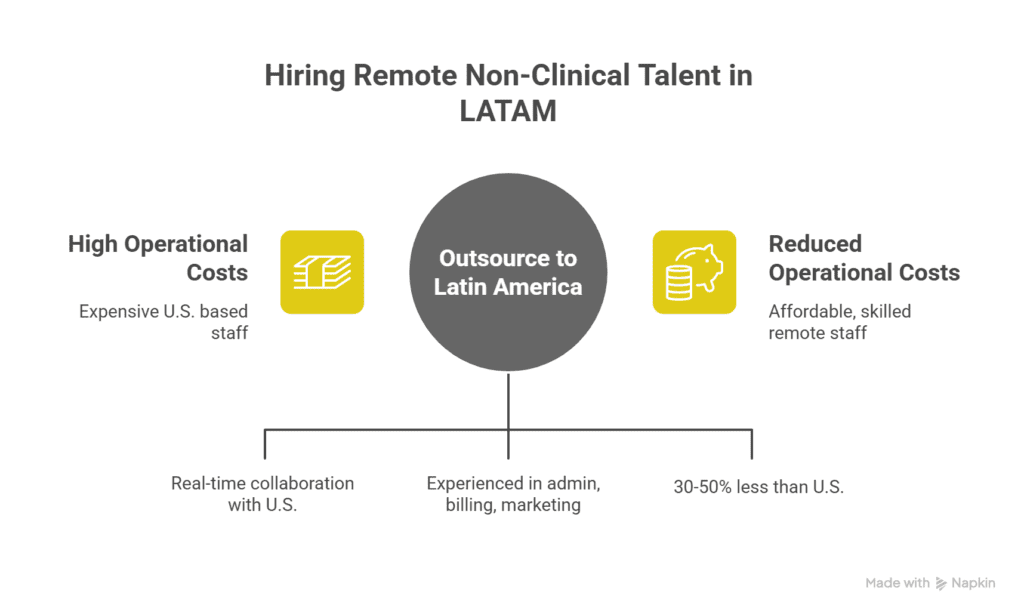
Teams in Latin America operate within time zones close to or overlapping with the U.S., ensuring real-time collaboration during standard business hours. This alignment reduces delays in communication, enabling faster decision-making and seamless workflow integration.
For example, countries like Mexico (CST) and Colombia (EST) share similar working hours with major U.S. cities, making them ideal for roles requiring constant interaction, such as customer support or administrative coordination.
Talent Availability in Admin, Billing, and Marketing Roles
The region has a growing pool of professionals experienced in administrative tasks, medical billing processes, and digital marketing strategies.
Many candidates possess bilingual proficiency in English and Spanish, which is critical for patient communications or managing diverse client bases. Many platforms showcase profiles of skilled individuals specializing in data entry, insurance claims processing, content creation, and campaign management—roles essential to scaling healthcare operations efficiently.
Cost Structure Compared to U.S.-Based and Offshore Options
Hiring from Latin America often costs 30%-50% less than employing U.S.-based staff while maintaining competitive quality standards.
Compared to offshore options like Southeast Asia or Eastern Europe, you benefit from lower turnover rates due to cultural compatibility with Western work ethics. For instance, a virtual assistant from Argentina may charge $10-$15 per hour versus $25-$35 per hour for their U.S.-based counterpart without compromising productivity or expertise levels.
Which Roles to Hire Remotely from Latin America
Hiring non-clinical remote talent from Latin America offers access to skilled professionals in various roles. These positions align with the region’s strengths, including bilingual capabilities, cost efficiency, and time zone compatibility.
Patient Coordinators, Billers, and Admin Support
You can find experienced patient coordinators who handle appointment scheduling, follow-ups, and communication seamlessly in English and Spanish.
Medical billers from Latin America are proficient in coding systems like ICD-10 and CPT while managing claims processing efficiently. Administrative support staff excel at data entry, document management, and operational tasks that keep your practice running smoothly.
Digital Marketing, Content, and CRM Management
Digital marketers in Latin America specialize in SEO strategies, social media campaigns, email marketing automation tools like HubSpot or Mailchimp, and analytics platforms such as Google Analytics.
Content creators deliver high-quality blogs or website copy tailored for healthcare audiences. CRM managers ensure customer relationship tools like Salesforce are optimized for lead tracking and engagement.
Executive Assistants and Practice Operations Support
Executive assistants provide calendar management, travel coordination, meeting preparation, and inbox organization to streamline your workflow. Professionals supporting practice operations oversee compliance documentation, vendor communications, payroll assistance, and inventory tracking for medical supplies.
How Wow Remote Teams Will Help You Hire Top Non-Clinical Talent
Building a skilled remote team from Latin America offers immense potential for cost savings, operational efficiency, and access to bilingual professionals. With the right approach, you can streamline hiring, ensure compliance, and foster a productive work environment that aligns with your organizational goals.
By leveraging proven strategies and trusted resources, you’ll be well-equipped to find top non-clinical talent while navigating regional nuances effectively. A structured process ensures you not only hire qualified candidates but also set them up for long-term success within your organization.
Investing in thoughtful planning and ongoing management of your LATAM remote workforce will position your business for sustainable growth while maintaining high standards of service delivery.
Recommended Resources for Healthcare Hiring & Remote Staffing
- Nearshoring for Medical Practices
- Strategies to Reduce Turnover in Healthcare Practices
- Virtual Medical Assistant Tasks
- On-Site vs Virtual Medical Staff
- Best Countries to Hire Healthcare Support Roles in Latin America
- 7 Common Tasks Healthcare Providers Outsource to LATAM
- What Is a Virtual Medical Assistant?
- Top Remote Roles Healthcare Providers Can Hire in Latin America
- Benefits of Partnering with a Remote Healthcare Staffing Agency
- Medical Practice Recruitment Strategies
Frequently Asked Questions
Why is Latin America a good region for hiring non-clinical remote talent?
Latin America offers proximity to the U.S., a skilled bilingual workforce, and cost savings of 30%-50% compared to U.S.-based staff. The region also has professionals experienced in healthcare operations, making it ideal for roles like medical billing, customer support, and administrative tasks.
What types of non-clinical roles can be hired remotely from Latin America?
Organizations can hire patient coordinators, medical billers, administrative support staff, digital marketers, and executive assistants. These roles are well-suited for remote work due to their reliance on communication tools and software systems.
How do I ensure HIPAA compliance when hiring remote talent?
To maintain HIPAA compliance, provide secure communication channels, train employees on data privacy protocols, and use contracts that address confidentiality obligations. Partnering with agencies familiar with healthcare regulations can also help ensure compliance.
Should I hire contractors or use an Employer of Record (EOR) in Latin America?
Contractors offer flexibility but require clear agreements regarding payment terms and responsibilities. An EOR simplifies compliance by managing payroll and legal requirements locally while ensuring adherence to labor laws.
What are the best platforms for sourcing LATAM remote talent?
Use specialized staffing agencies like Wow Remote Teams for pre-screened candidates. Additionally, explore LinkedIn’s advanced search filters, regional job boards like Computrabajo and Bumeran.
How should I evaluate remote candidates from Latin America?
Assess language proficiency using tools like Versant or IELTS. Evaluate technical skills relevant to the role and check cultural alignment through structured interviews. Ensure candidates have suitable home office setups for effective remote work.
What onboarding strategies work best for LATAM remote hires?
Provide immediate access to essential systems and create role-specific training modules. Use detailed SOPs during onboarding and align schedules with U.S. time zones to facilitate collaboration across teams.
How can I manage LATAM remote staff effectively?
Maintain consistent communication via Slack or Zoom and conduct quarterly performance reviews based on measurable KPIs. Use collaboration tools to integrate teams seamlessly while fostering engagement through mentorship programs.
When should I scale my LATAM remote team?
Scale your team by analyzing workload patterns and prioritizing critical functions. Centralize operations within a nearshore department for better oversight while standardizing processes across countries to manage compliance efficiently.
Are there cost advantages in hiring from Latin America compared to the U.S.?
Yes! Hiring from Latin America typically results in 30%-50% cost savings due to lower wages while still accessing highly skilled professionals who meet international standards of quality.